Programmatic Payments & Settlement Infrastructure for the Travel Supply Chain

A unified settlement layer for OTAs, bedbanks, and travel intermediaries. Reduce counterparty risk, eliminate operational complexity, and lower transaction costs across the distribution chain.
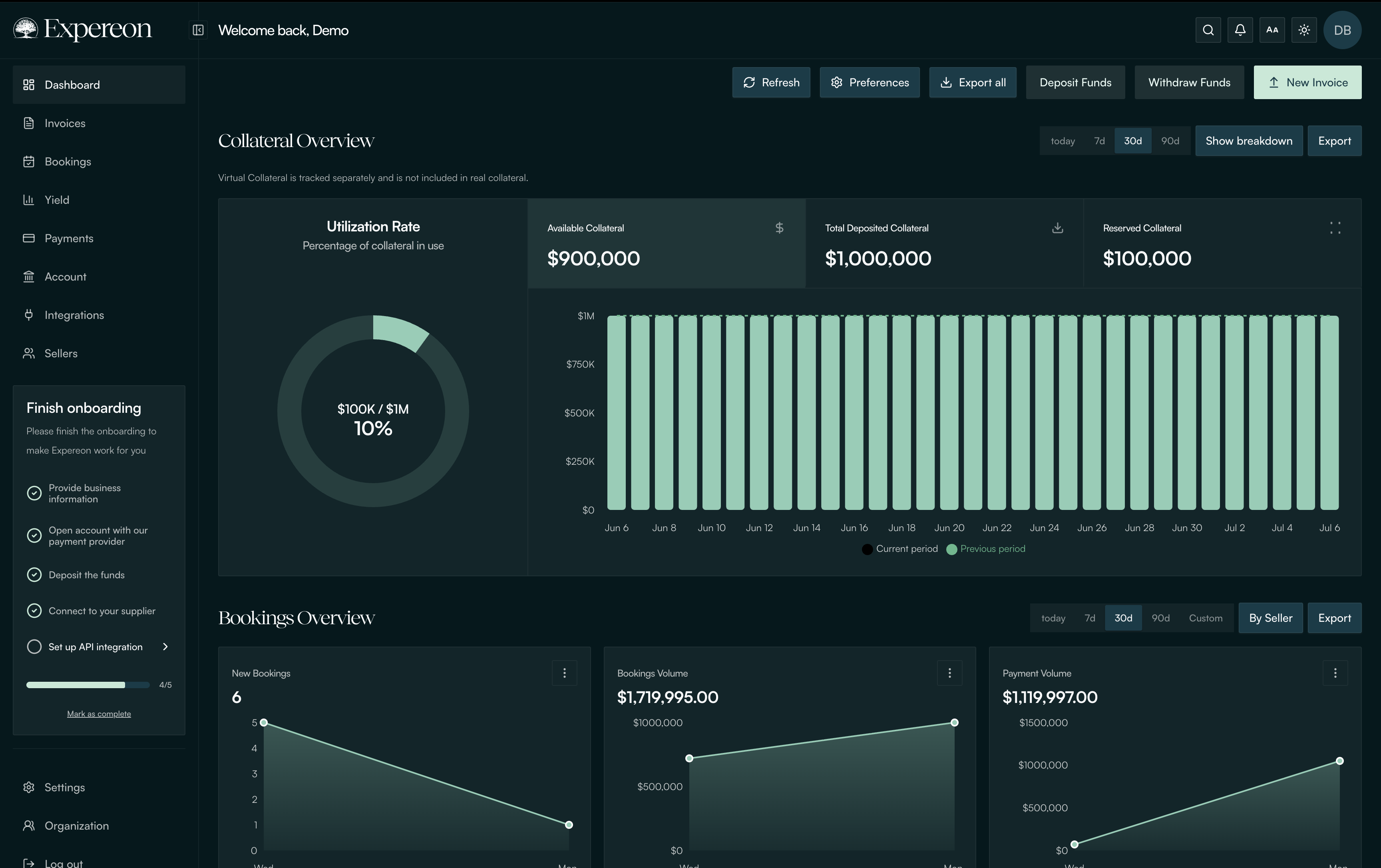
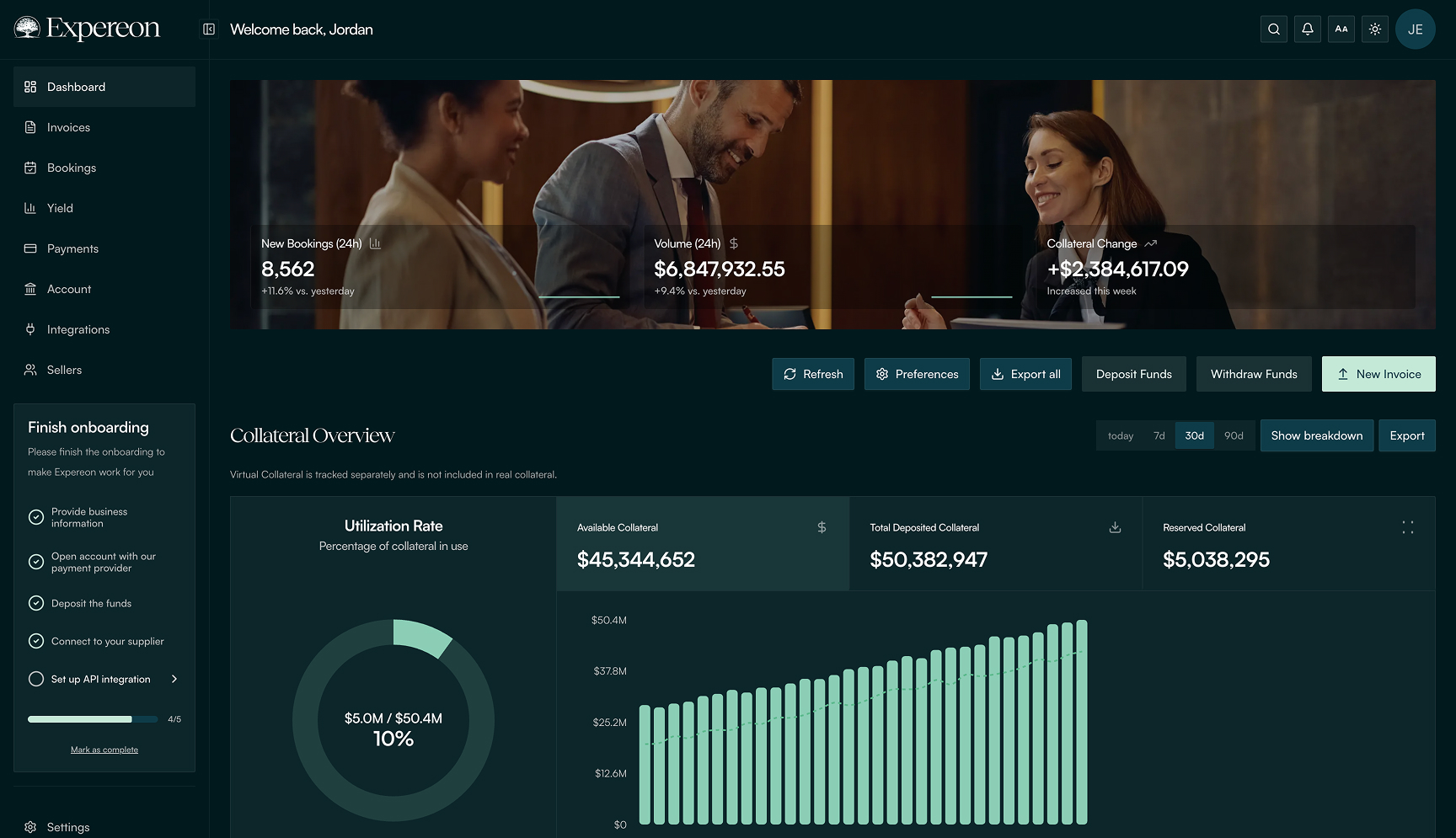
Collateral Management
Increased Profit Margins
Automatic Reconciliation
Travel distribution involves multiple actors exchanging bookings, funds, and data across complex networks. Settlement and payments are typically handled separately from operational workflows, creating friction, risk exposure, and unnecessary cost at every layer of the supply chain.

STRUCTURAL INEFFICIENCIES

Settlement in Travel Distribution

Travel distribution involves multiple actors exchanging bookings, funds, and data across complex networks. Settlement and payments are typically handled separately from operational workflows, creating friction, risk exposure, and unnecessary cost at every layer of the supply chain.

Counterparty Risk Exposure

No unified risk position
Without a centralised view of collateral obligations, assessing total counterparty exposure is manual and error-prone.
Delayed settlement increases exposure windows
Extended settlement cycles (T+7 to T+90) leave capital at risk for longer than necessary.

Operational Complexity

Manual reconciliation across counterparties
Finance teams spend significant hours matching invoices to bookings, resolving discrepancies, and managing exceptions across multiple supplier relationships.
Disconnected payment and booking systems
Settlement processes run independently of operational workflows, requiring manual coordination between finance, operations, and supplier management.
Exception handling at scale
As transaction volume grows, the rate of unmatched invoices, partial payments, and disputed amounts compounds operational burden.

Cost Leakage

Wire transfer fees of $25-50 per transaction
Traditional banking infrastructure imposes significant per-transaction costs that scale linearly with payment volume.
FX spreads of 50-100 bps on cross-border flows
Foreign exchange markups on international settlements represent a persistent drag on margins across the supply chain.
Correspondent banking fees and intermediary charges
Multi-hop payment corridors introduce additional fees at each stage, often without full transparency to the payer.

Bilateral Payment Complexity

N x N payment relationships
100 buyers and 100 suppliers generate up to 10,000 bilateral payment flows, each requiring individual processing and reconciliation.
No payment netting
Without a central clearing mechanism, every transaction is processed individually, multiplying both cost and operational effort.
Limited auditability
Fragmented systems make it difficult to produce consolidated reporting for compliance, audit, or management oversight.
The global hotel distribution market processes over $2.3T in annual GMV. An estimated $150bn remains held in bilateral deposits across the supply chain, generating limited or no return for the capital provider.
THE PLATFORM

A Coordinated Settlement Layer for Travel Payments

Expereon introduces a unified settlement platform purpose-built for the travel industry supply chain. Rather than replacing existing systems, the platform operates as an orchestration layer aligning operational and financial workflows to reduce risk, lower costs, and simplify multi-party settlement.

Core Capabilities

01
Programmatic Settlement
Rule-based payment execution
Settlements are triggered automatically based on configurable approval policies, payment terms, and counterparty rules.
Automated invoicing
Bookings submitted via API generate corresponding invoices without manual intervention.
Automated invoicing
Bookings submitted via API generate corresponding invoices without manual intervention.
02
Automated Reconciliation
Booking-linked ledger
Every payment maps to its source booking, providing full traceability from reservation through settlement.
Automated matching
Invoices are reconciled against bookings with 99%+ accuracy, flagging exceptions with structured reason codes.
Reduced dispute rate
Fewer mismatches and faster exception resolution reduce operational overhead by 60-80%.
03
Unified Collateral Management
Single collateral pool
Replace per-supplier deposit requirements with a centralised pool, improving capital efficiency and simplifying treasury management.
Dynamic allocation
Collateral is allocated and reserved at the invoice level, providing granular visibility into utilisation.
Yield generation
Idle collateral earns returns while maintaining its function as a payment guarantee. Yield programmes are available as a supplementary feature.
04
Lightweight Integration
RESTful API
A documented, well-structured API enables booking submission, invoice retrieval, and settlement status queries.
CSV and batch upload
For organisations not yet API-ready, bulk file upload is supported from day one.
Webhook notifications
Real-time event-driven notifications for invoice creation, approval, settlement, and exceptions.

How Payments Change

Current State

100 OTAs x 100 Suppliers = 10,000 individual payments
Supplier invoices, manual reconciliation, error correction
Multiple FX conversions, multiple wire transfers
Per-supplier deposits held bilaterally

With Expereon

100 in + 100 out = 200 netted payments
Automated invoicing and reconciliation
Optimised FX corridors, programmatic settlement
Single collateral pool with dynamic allocation
Quantified Impact

Measurable Reduction in Risk, Cost, and Complexity

The platform generates measurable financial and operational impact across the supply chain. The figures below are derived from industry benchmarks and pilot programme modelling.
Minutes

Settlement Time (vs. T+7-14 standard)

Approved invoices settle within minutes, reducing counterparty exposure windows from weeks to near-real-time.
90%+

Reduction in Transaction Cost

Per-transaction costs reduce from $25-100 (wire transfer) to $1-5 per settlement event.
20-40 bps

FX Optimisation Savings

Smart corridor routing selects the lowest-cost FX path for each cross-border payment.
60-80%

Reduction in Reconciliation Effort

Automated matching and exception handling reduce back-office processing time significantly.
$11-18M
per $1bn GMV

Net Financial Impact

Combined value of reduced transaction costs, FX savings, operational efficiency, and lower insurance/bridging requirements across the supply chain.

Impact by Participant

Participant
Impact Areas
Estimated Value per $1bn GMV
OTA
Deposit yield, FX corridor savings, automated reconciliation
+$5-10M annually
Bedbank
Reduced credit insurance, lower bridging costs, streamlined collections
+$4-5M annually
Total ecosystem value:
$11-18M per $1bn GMV
Financial Impact Assessment

Estimate Your Operational Savings

Use the parameters below to model the financial impact of the platform based on your current settlement volume and operational profile.
Platform Comparison

Settlement Infrastructure:
Legacy vs. Programmatic

A comparison of settlement capabilities between traditional banking infrastructure and the Expereon platform.
Capability
Expereon Platform
Traditional Banking
Settlement Speed
Minutes from approval
T+7 to T+90 depending on corridor
Per-Transaction Cost
$1-5
$25-100 (wire + correspondent fees)
Collateral Structure
Unified pool with dynamic allocation
Per-supplier bilateral deposits
Reconciliation
Automated, booking-linked
Manual, spreadsheet-based
FX Execution
Smart corridor routing, 20-40 bps improvement
Bank-quoted rates, limited transparency

Explore Whether Expereon Fits Your Settlement Requirements

We work with OTAs, bedbanks, and travel intermediaries managing multi-party settlement across the hotel supply chain. If you are evaluating alternatives to your current payment infrastructure, we welcome the opportunity to discuss your requirements.
Request a Consultation
30-minute introductory call to review your current settlement workflow and assess platform fit.
Download Overview
A concise summary of platform capabilities, integration options, and financial impact modelling in PDF format.